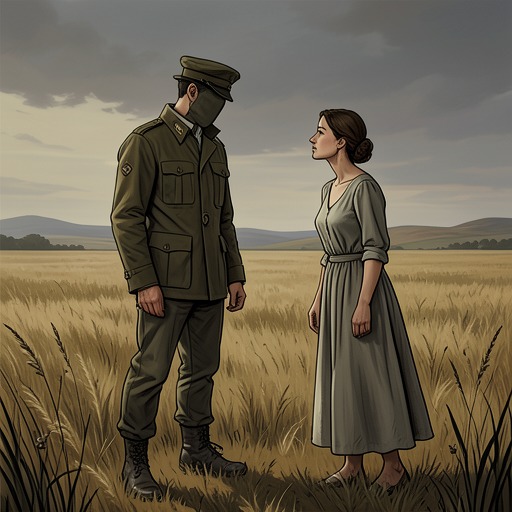
Ruth
The Narrow Road to the Deep NorthRuth, known for years to Dorrigo Evans only as Mrs Jackie Maguire, becomes the focus of a belated family revelation. Her story emerges not through her own account but through Dorrigo’s long-unsettled memory and Tom Evans’s confession in hospital: Ruth had a son by Tom, concealed the birth, and lost the child to another family’s care. The boy, Frank, later died in a prisoner-of-war camp in Thailand, while Tom never met him. Ruth’s brief remembered presence thus connects a private secret to the war’s wider losses.
Identity and Background
Ruth was an Aboriginal woman living in Cleveland and married to Jackie Maguire, a man whom Tom described as loving her but substantially older. Dorrigo had heard vague accounts that Jackie’s wife had aristocratic Spanish ancestry, a story presented as one of the traditional Tasmanian alibis; he had not known she was Aboriginal. That gap in his knowledge matters to the recollection: Ruth had been near the centre of a memory that shaped him, yet even her identity had been obscured from him.
Her marriage was unhappy. Tom said Jackie was sometimes violent toward her, particularly when drinking, and that Ruth was twenty years younger and dissatisfied with the relationship. The account supplies no fuller portrait of Ruth’s thoughts or plans, but it establishes the constraints around her life in Cleveland and helps explain why her eventual departure remained a question for Dorrigo. Tom could describe the circumstances he had witnessed; he could not say where she went until a letter reached him much later.
The Memory and Its Disclosure
Dorrigo’s recollection begins with a scene he had seen shortly before Ruth disappeared. He remembered her holding Tom and initially wondered whether they had been kissing. Tom corrected that impression: he had been returning from rabbit shooting, found Ruth hanging washing, and helped her with it. As they talked about family and people, he began telling her things he had seen during the war. He became distressed, unable to speak properly, and Ruth held him. Tom remembered the episode as an occasion when she comforted him, not as a romantic encounter.
The memory gives Ruth a particular place in the brothers’ history: she was the person to whom Tom disclosed wartime experiences he had not really told anyone. Dorrigo had carried the image without understanding its circumstances, and his question about Ruth’s disappearance brings the hidden story forward. When Tom later calls out her name, Dorrigo turns back to the hospital bed. The disclosure is framed by Tom’s frailty and by Dorrigo’s recognition that the brother he had remembered as vigorous has become very ill; within that conversation, Tom speaks with renewed firmness about what happened.
The Secret Child
Ruth had already borne two children when she gave birth to her third, a boy, in July 1920. Tom said that Jackie was away seeking work on the mainland, possibly near the Diamantina, and never knew about the pregnancy or baby. No one in Cleveland knew either. Ruth wore loose clothing that helped conceal the pregnancy, gave birth in Launceston, and the baby was sent to Hobart. Tom said she told him about the child when she had just learned what had happened to it, on the same day she had comforted him as he struggled to speak about the war.
Tom then disclosed that he was the baby’s father. A family named Gardiner, described as well-to-do, was raising the boy. The arrangement distressed both Ruth and Tom, but Tom explained that they feared claiming the child would disrupt the lives of everyone involved: the boy, his caregivers, Ruth, Tom, and Jackie. They did not seek to bring him back. His account presents the decision as something they had to live with, while also making plain its cost: Tom had a son he never met.
Departure and Aftermath
Ruth’s later life is known through a letter that reached Tom in Sydney. She had gone first to Melbourne and later to New Zealand, where she married a bricklayer in Otago. The letter said little; a note from her daughter explained that Ruth had asked for it to be posted after her death. It did not mention Jackie or the family she had left in Tasmania, and Tom considered that the possibility of others reading it might explain the omissions. The account gives no further details of her life abroad or of her death.
Tom learned later, through a Hobart acquaintance who knew the Gardiner family, that the boy had been named Frank. Frank died during the war in one of the prisoner-of-war camps in Thailand, the same kind of camp in which Dorrigo had been held. Tom never met his only son. Ruth’s story therefore ends in separation across several stages: a concealed birth, a child raised elsewhere, her own departure from Tasmania, and a death Tom learned about indirectly. Her limited appearance in the narrative carries the weight of what the family did not know, did not say, and could not recover.